
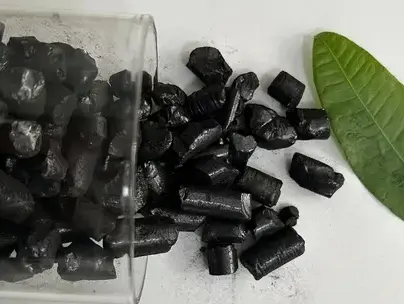
Coal tar pitch is the heavy, carbon-rich residue left after coal tar is processed by distillation. It is generally black or dark brown, may be solid or semi-solid at room temperature, and softens over a range of temperatures rather than having one precise melting point.
Because of its binding properties and high carbon content, Coal tar pitch has historically been used in industrial applications such as aluminum smelting, carbon products, specialty coatings, and certain construction materials. However, it also requires careful handling because heating can release hazardous coal tar pitch volatiles.
How Is Coal Tar Pitch Produced?
Coal tar is generated as a byproduct during the production of coke from coal. It is a complex mixture containing many organic compounds.
When coal tar is heated and distilled, lighter fractions are separated for further chemical processing. The heavier material that remains is called coal tar pitch.
The exact properties of the pitch can vary according to:
- Coal source
- Coke-making process
- Distillation conditions
- Refining method
- Softening-point specification
- Insoluble content
- Ash content
- Volatile matter
This is why buyers should review a supplier’s technical data sheet instead of assuming that all coal tar pitch grades perform the same way.
What Does Coal Tar Pitch Look Like?
Coal tar pitch is usually black, glossy, and brittle in solid form. It may be supplied as blocks, flakes, granules, powder, or a heated liquid, depending on the industrial process.
At higher temperatures, it becomes softer and more workable. Its broad softening range makes it useful as a binder in carbon-based manufacturing, but it also means that temperature control is important during storage, transport, and processing.
Common Uses of Coal Tar Pitch
Aluminum Smelting
One major application is as a binder for carbon anodes used in primary aluminum production. The pitch helps bind carbon materials together before baking, creating an anode structure suitable for the electrolytic smelting process.
Graphite Electrodes and Carbon Products
Coal tar pitch can be used in the manufacture of graphite electrodes, carbon blocks, refractory products, and other carbon-based materials. Its carbon yield and binding properties support these specialized processes.
Specialty Coatings and Materials
Some coal tar pitch products have been used in protective coatings, waterproofing materials, and industrial chemical formulations. Product selection must account for the project’s technical requirements and current environmental or regulatory restrictions.
Chemical Feedstock
Coal tar pitch can also be processed to recover or produce carbon-rich materials for further industrial use, including needle coke and other high-value carbon products.
Coal Tar Pitch vs. Asphalt
Coal tar pitch and petroleum asphalt are both dark, viscous, carbon-rich materials, but they come from different sources and have different chemical compositions.
Coal tar pitch originates from coal tar processing. Petroleum asphalt, often called bitumen, is derived from crude-oil refining. Their performance characteristics, compatibility, environmental profiles, and regulatory treatment can differ significantly.
For this reason, they should not be substituted for one another without technical approval.
Why Softening Point Matters
Coal tar pitch is often classified by softening point. This property indicates the temperature range in which the material begins to soften and flow under defined test conditions.
A suitable softening point helps manufacturers control mixing, molding, impregnation, baking, and final-product performance. The correct grade depends on the process temperature, desired viscosity, carbon residue, and end-use requirements.
Health and Safety Considerations
Coal tar pitch should be handled as a hazardous industrial material. When heated, it can release coal tar pitch volatiles containing polycyclic aromatic hydrocarbons, or PAHs. Occupational exposure can occur through inhalation, skin contact, and eye contact.
The U.S. Occupational Safety and Health Administration describes coal tar pitch as a black or dark-brown residue from coal tar processing and notes that heating can make chemical vapors airborne.
NIOSH considers coal tar products, including coal tar pitch, potential occupational carcinogens and recommends controlling exposure.
Employers should use appropriate engineering controls, local exhaust ventilation, exposure monitoring, protective clothing, gloves, eye protection, hygiene measures, and respiratory protection where required by the hazard assessment and local regulations. Workers should always follow the product safety data sheet.
Choosing a Coal Tar Pitch Grade
Industrial buyers should confirm more than price and appearance. Important specifications may include:
- Softening point
- Fixed carbon
- Volatile matter
- Ash content
- Moisture content
- Sulfur content
- Quinoline-insoluble and toluene-insoluble fractions
- Particle size or delivery form
- Intended application
- Packaging and transport requirements
A correctly specified Coal tar pitch grade supports more consistent processing and helps reduce quality variation in downstream products.
Conclusion
Coal tar pitch is the heavy residue left after coal tar distillation. It is a carbon-rich industrial material valued for its binding properties and use in aluminum, graphite, carbon, and specialty-material production.
Because its composition and performance vary by grade, buyers should rely on technical specifications and approved handling procedures. Safe storage, controlled heating, and effective exposure management are essential whenever Coal tar pitch is used in industrial operations.
Post time: 07-23-2026