
Coal tar pitch should be identified through a combination of supplier documentation, batch traceability, physical-property testing, and laboratory analysis. Its dark appearance alone is not enough to confirm its identity because asphalt, petroleum pitch, resin residues, and other carbon-rich materials can look similar.
A reliable identification process starts with the Safety Data Sheet (SDS), Certificate of Analysis (COA), product grade, and batch number. Where material identity is uncertain, an accredited laboratory should perform appropriate testing. Do not heat, burn, smell, or handle an unknown sample without suitable industrial controls.
Quick answer: how to identify coal tar pitch
| Identification method | What it can confirm | Reliability |
|---|---|---|
| SDS and COA review | Product name, grade, hazard information, supplier details, declared properties | High when documents are traceable |
| Batch number and supply records | Material origin and production traceability | High when matched to supplier records |
| Visual inspection | Colour, texture, form, and visible contamination | Preliminary only |
| Softening-point testing | Whether the sample matches the specified pitch grade | Useful quality-control method |
| Ash and volatile-matter testing | Product consistency and impurity level | Useful for grade comparison |
| Laboratory chemical analysis | PAH profile and material composition | Best method for uncertain samples |
| Application performance testing | Suitability for electrode, refractory, carbon, or binder use | Important for final acceptance |
The most dependable approach is to compare laboratory results and physical properties with the supplier’s approved specification.
What is coal tar pitch?
Coal tar pitch is the high-boiling residue produced during the distillation of coal tar. It is a complex mixture rather than a single pure chemical. Its composition can include polycyclic aromatic hydrocarbons and related carbon-rich compounds.
Depending on the grade and processing method, coal tar pitch may be used as a binder or raw material in applications such as:
- Graphite electrodes
- Carbon anodes
- Refractory materials
- Carbon blocks
- Foundry materials
- Specialty carbon products
- Industrial binder systems
Because coal tar pitch can vary by source, distillation condition, softening point, and intended application, buyers should identify the specific grade rather than relying only on the general product name.
Start with the SDS and Certificate of Analysis
The first step in identifying coal tar pitch is reviewing supplier documents.
A complete SDS should provide:
- Product name
- Hazard classification
- Composition information
- Handling instructions
- Storage guidance
- Personal protective equipment requirements
- First-aid information
- Transport information
- Regulatory details
A Certificate of Analysis should provide batch-specific quality data. Depending on the product grade, this may include:
- Softening point
- Ash content
- Volatile matter
- Moisture content
- Density
- Quinoline-insoluble content
- Toluene-insoluble content
- Coking value
- Particle size, if supplied as powder
- Packaging and batch information
Documents are most useful when the SDS, COA, packaging label, batch number, purchase order, and shipment records all match.
Physical characteristics of coal tar pitch
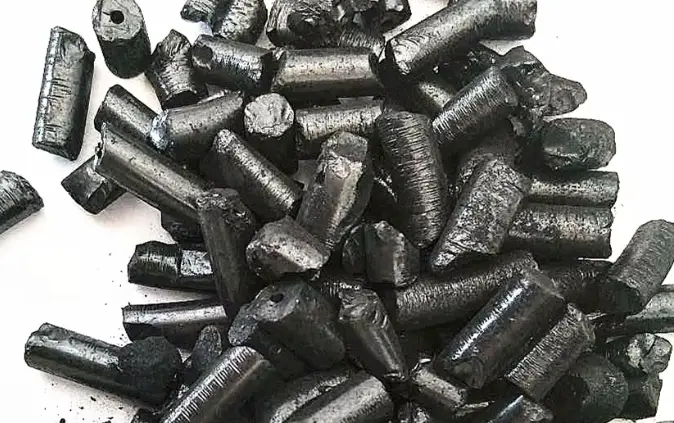
Coal tar pitch is commonly dark brown to black. It may appear as a solid, brittle material, granules, flakes, powder, or a viscous mass depending on its grade and temperature.
Typical visual characteristics may include:
- Black or dark-brown colour
- Amorphous appearance
- Glossy, dull, brittle, or glassy fracture surfaces
- Granular, flaked, powdered, or block form
- A change in hardness with temperature
- Dark staining on contaminated packaging or equipment
These features can support an initial inspection, but they cannot confirm chemical identity. Asphalt, petroleum-derived pitch, some resins, and contaminated carbon materials may have a similar appearance.
Why appearance is not enough
A dark, carbon-rich material should never be identified as coal tar pitch only because it looks black or has a tar-like texture.
Several materials can be mistaken for coal tar pitch:
| Material | Why it may look similar | Key distinction |
|---|---|---|
| Coal tar | Dark colour and aromatic hydrocarbon content | Coal tar is generally less distilled and more fluid than pitch |
| Petroleum asphalt | Dark, viscous, and carbon-rich | Derived from petroleum rather than coal tar |
| Petroleum pitch | Dark residue with binder properties | Different origin and chemical profile |
| Resin or polymer residue | Can be black, hard, or brittle | Different composition and thermal behaviour |
| Carbon black mixture | Dark powdered material | Usually has a different particle structure and binder system |
| Contaminated industrial residue | Variable dark appearance | Requires laboratory confirmation |
For procurement and quality control, the product should be accepted only after it matches the agreed specification.
Laboratory methods for identifying coal tar pitch
When a sample is unknown or disputed, laboratory testing is the correct route. Because coal tar pitch is a complex mixture, no single universal test provides every answer.
Chemical fingerprint analysis
Laboratories may use chemical-analysis methods to evaluate the sample’s hydrocarbon composition and polycyclic aromatic hydrocarbon profile. This can help distinguish coal tar pitch from petroleum-derived materials or other industrial residues.
Infrared analysis
Infrared spectroscopy can be used as a screening tool to compare an unknown sample with verified reference material. It is useful for identifying broad material differences, but results should be interpreted by qualified laboratory personnel.
Softening-point test
Softening point is a key quality property for many coal tar pitch grades. A sample that does not meet the specified softening-point range may be the wrong grade, degraded material, contaminated material, or a different pitch product.
Ash-content test
Ash content measures inorganic residue after controlled testing. High ash content may indicate contamination, mineral impurities, poor raw-material control, or an unsuitable grade for carbon-product applications.
Insoluble-content testing
Quinoline-insoluble and toluene-insoluble fractions are commonly used to evaluate the structure and consistency of pitch products. These values can affect binder performance, coke yield, processing behaviour, and suitability for downstream applications.
Moisture and volatile-matter testing
Moisture and volatile matter can affect storage, handling, heating performance, mixing behaviour, and final-product quality. These tests are particularly important for powdered pitch and products used in high-temperature carbon processing.
How to identify the correct coal tar pitch grade
Coal tar pitch grades are selected according to end use. A suitable grade for one application may not be appropriate for another.
Before approving a material, confirm:
- Required softening-point range
- Ash-content limit
- Moisture limit
- Volatile-matter requirement
- Insoluble-content specification
- Particle-size distribution
- Packaging format
- Storage condition
- Intended application
- Required laboratory test method
- Batch acceptance criteria
For example, a pitch used as a carbon binder may require different physical properties from a pitch intended for refractory production or another industrial process.
Coal tar pitch safety during identification
Coal tar pitch and its volatile components can present occupational-health risks. Coal tar products may contain compounds of health concern, including polycyclic aromatic hydrocarbons.
For this reason, unknown or suspect materials should be handled with a precautionary approach.
Do not:
- Heat an unknown sample to assess its smell or flow behaviour
- Burn a sample to “test” its identity
- Touch the material with unprotected skin
- Create dust from powdered material
- Use compressed air to clean contaminated surfaces
- Conduct informal testing in an unventilated area
Industrial handling should follow the product SDS, local regulations, site procedures, and qualified occupational-health guidance. Appropriate controls may include ventilation, containment, protective clothing, gloves, eye protection, and exposure monitoring where required.
How to avoid buying the wrong material
A strong purchasing process is the best way to prevent material-identification problems.
Before placing an order, request:
- A current SDS
- A batch-specific COA
- Product technical data sheet
- Softening-point specification
- Ash and moisture limits
- Insoluble-content requirements
- Packaging details
- Sample availability
- Inspection and testing procedure
- Clear acceptance and rejection criteria
For large or critical orders, retain an approved reference sample and test incoming batches against the agreed specification.
Conclusion
Coal tar pitch cannot be reliably identified by colour, texture, or smell alone. The best identification method combines verified supplier documents, batch traceability, physical-property testing, and laboratory analysis.
For industrial procurement, the key is not simply confirming that a material is coal tar pitch. It is confirming that it is the correct coal tar pitch grade for the intended application, with consistent properties and controlled quality.
For coal tar pitch product information, samples, or technical purchasing enquiries, contact Fentaiyuan.
FAQ
What does coal tar pitch look like?
Coal tar pitch is commonly dark brown to black and may appear as a brittle solid, granules, flakes, powder, blocks, or a viscous material depending on its grade and temperature. Appearance is only a preliminary clue, not proof of identity.
Can you identify coal tar pitch by smell?
No. Smelling an unknown material is not a safe or reliable identification method. Coal tar pitch and related volatile compounds can create occupational-health risks. Use documentation and qualified laboratory testing instead.
What is the best test for coal tar pitch?
The best approach combines SDS and COA review with batch traceability, softening-point testing, ash-content testing, insoluble-content testing, and laboratory chemical analysis when needed.
How is coal tar pitch different from asphalt?
Coal tar pitch is derived from coal tar distillation, while asphalt is generally petroleum-derived. Both can be dark and carbon-rich, but they differ in origin, composition, performance, and suitable industrial applications.
Post time: 09-29-2026