

Coal tar pitch and hot asphalt are both dark, carbon-rich binding materials, but they are not interchangeable products. In controlled industrial formulation work, selected coal-tar-derived components may be incorporated into asphalt-based systems. However, this does not mean that Coal tar pitch should be added directly to hot asphalt on a construction site or used as a general-purpose asphalt modifier.
The practical answer is: a blend may be technically possible only when a qualified formulation, controlled process, safety assessment, and project specification support it. It should not be treated as a simple field-mixing operation.
Coal tar pitch is a complex residue derived from coal tar processing, while conventional paving asphalt is generally petroleum-derived. Their composition, compatibility, emissions profile, handling requirements, and approved uses can differ substantially.
Why Would Coal Tar Pitch Be Considered for Asphalt Blending?
Historically, coal-tar-derived materials have been used in some coatings, waterproofing products, roofing systems, sealants, and specialty industrial formulations. In research or product-development settings, a coal-tar-pitch component may be evaluated to alter properties such as stiffness, softening behavior, temperature response, adhesion, or resistance to particular service conditions.
However, material performance is formulation-specific. The result depends on many variables, including:
- Coal tar pitch composition and softening range
- Asphalt binder grade and source
- Blend ratio
- Mixing temperature and mixing time
- Additives, modifiers, or crosslinking agents
- Intended application
- Storage stability
- Local environmental and occupational requirements
A result obtained with one raw material source or laboratory formula cannot be assumed to apply to another project.
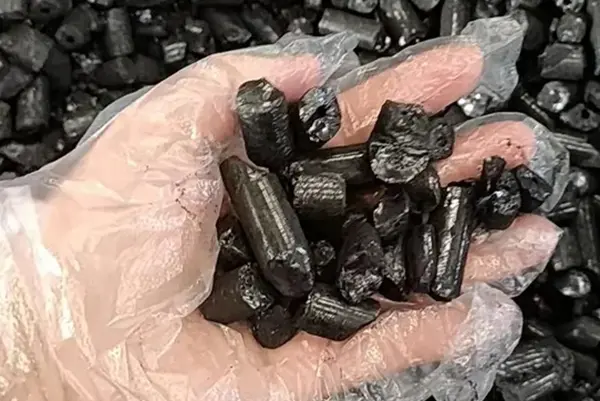
Coal Tar Pitch and Asphalt Are Not the Same Material
Coal tar pitch is a dark, amorphous residue produced from coal tar processing. It has a broad softening range rather than one precise melting temperature. Asphalt, often called bitumen in many markets, is also a complex material but is typically produced through petroleum refining or related processing routes.
Because the materials have different chemical profiles, a blend may not behave like a conventional paving binder. Changes in viscosity, storage stability, adhesion, brittleness, odor, emissions, and aging performance should be evaluated before use.
For this reason, project teams should avoid relying on color, appearance, or apparent fluidity as evidence that the materials are compatible.
Can Coal Tar Pitch Be Added to Hot Asphalt in the Field?
Field addition is generally not an appropriate default approach.
Heating and mixing can create exposure concerns, particularly when coal-tar-pitch volatiles become airborne. Coal tar products are treated by occupational-health authorities as potential occupational carcinogens, and exposure controls should be based on the actual process, temperature, material safety data, ventilation conditions, and applicable local requirements.
A site team should not add Coal tar pitch to hot asphalt unless the work is supported by:
- A documented and approved formulation
- Project-specific technical specifications
- Relevant material safety data
- A reviewed heating and mixing procedure
- Exposure-control measures
- Environmental and waste-management planning
- Qualified engineering and safety oversight
- Compliance with local laws and client requirements
The correct approach is to purchase or manufacture a verified product through a controlled process, rather than improvising a blend during paving, roofing, coating, or waterproofing work.
Key Technical Risks of Unverified Blending
Inconsistent Performance
Coal tar pitch varies by source and processing history. Asphalt also varies by grade and refinery source. Without laboratory validation, the blend may have inconsistent viscosity, poor storage stability, or unsuitable performance at high or low temperatures.
Separation During Storage
A blend that appears uniform immediately after mixing may separate during transport or storage. This can lead to inconsistent material properties from one part of a tank or batch to another.
Unsuitable Application Behavior
A blend may affect pumpability, workability, curing behavior, surface adhesion, or coating performance. For paving materials, it may also affect compaction and long-term pavement behavior. For waterproofing or coating work, adhesion and film integrity require separate verification.
Increased Worker Exposure
Heating coal-tar-pitch-containing materials can release volatile compounds. NIOSH identifies coal tar, coal tar pitch, and creosote as coal-tar products and considers related exposures a potential occupational-carcinogen concern.
Specification and Regulatory Conflict
A project may specify petroleum asphalt, modified asphalt, or a named proprietary coating. Substituting or adding a coal-tar-pitch component without written approval can create quality, warranty, compliance, and liability issues.
What Should Be Tested Before Using a Coal-Tar-Pitch Blend?
Before a coal-tar-pitch-containing blend is considered for a commercial application, technical teams should evaluate the finished formulation rather than relying on raw-material assumptions.
| Evaluation Area | Why It Matters |
|---|---|
| Compatibility | Confirms whether the components form a stable blend. |
| Viscosity and workability | Helps determine handling, pumping, mixing, and application behavior. |
| Storage stability | Checks whether separation occurs over time. |
| Softening and temperature response | Indicates behavior during heating and service conditions. |
| Adhesion | Important for paving, coatings, waterproofing, and substrate bonding. |
| Aging resistance | Helps assess changes after heat, air, weather, or service exposure. |
| Emissions and exposure assessment | Supports safe process design and worker protection. |
| Environmental review | Confirms applicable disposal, release, and regulatory requirements. |
| Project specification compliance | Ensures the formulation is allowed for the intended use. |
Testing requirements should be determined by the product type, project location, customer specification, and applicable standards.
Worker Safety and Exposure Control
The safety profile of a coal-tar-pitch-containing product should be assessed before heating, mixing, spraying, brushing, pumping, or applying it.
Controls may include enclosed handling where practical, local exhaust ventilation, temperature control, exposure monitoring, protective clothing, skin-contact prevention, hygiene procedures, and worker training. The appropriate controls depend on the material, process, exposure route, and governing requirements.
In the United States, OSHA lists an 8-hour time-weighted permissible exposure limit of 0.2 mg/m³ for coal-tar-pitch volatiles, measured as a benzene-soluble fraction. NIOSH lists a 0.1 mg/m³ recommended exposure limit over a 10-hour time-weighted average, measured as a cyclohexane-extractable fraction. These are different measurement bases and time periods, so they should not be treated as directly interchangeable project limits.
Better Procurement Approach
For buyers, contractors, and product developers, the safer approach is to specify the required finished material performance instead of asking whether bulk Coal tar pitch can simply be blended with hot asphalt.
A procurement brief should define:
- Intended application
- Substrate and service environment
- Required temperature performance
- Required adhesion and durability
- Applicable regulations and specifications
- Handling and storage conditions
- Worker-exposure controls
- Product documentation requirements
- Batch traceability and quality-control expectations
This approach reduces the risk of incompatible materials, uncontrolled emissions, and failed project performance.
Final Thoughts
Coal tar pitch can be part of certain controlled industrial formulations, but it should not be assumed to blend safely or suitably with hot asphalt in every situation. Compatibility, process conditions, emissions, performance, and regulatory requirements must all be evaluated for the exact materials and application.
For any paving, coating, roofing, or waterproofing project, use a verified formulation and obtain review from qualified materials, safety, and project professionals before introducing coal-tar-derived components into a hot asphalt system.
For product or purchasing inquiries, please contact our team.
FAQ
Can coal tar pitch mix with asphalt?
It may be possible in a controlled and validated formulation, but the materials should not be mixed casually or directly in the field. The exact materials, blend ratio, processing conditions, safety controls, and project specification must be assessed.
Is coal tar pitch the same as asphalt?
No. Coal tar pitch is derived from coal tar processing, while conventional asphalt is generally petroleum-derived. They can differ in composition, handling behavior, emissions, and intended applications.
Is it safe to heat coal tar pitch?
Heating can release coal-tar-pitch volatiles. The material should be handled only under an approved process with appropriate engineering controls, protective measures, exposure assessment, and compliance review.
Can coal tar pitch be used for road paving?
Any use in paving must be determined by the approved project specification, local requirements, validated formulation, and professional technical review. It should not be substituted for conventional paving asphalt without written approval.
Post time: 10-21-2026